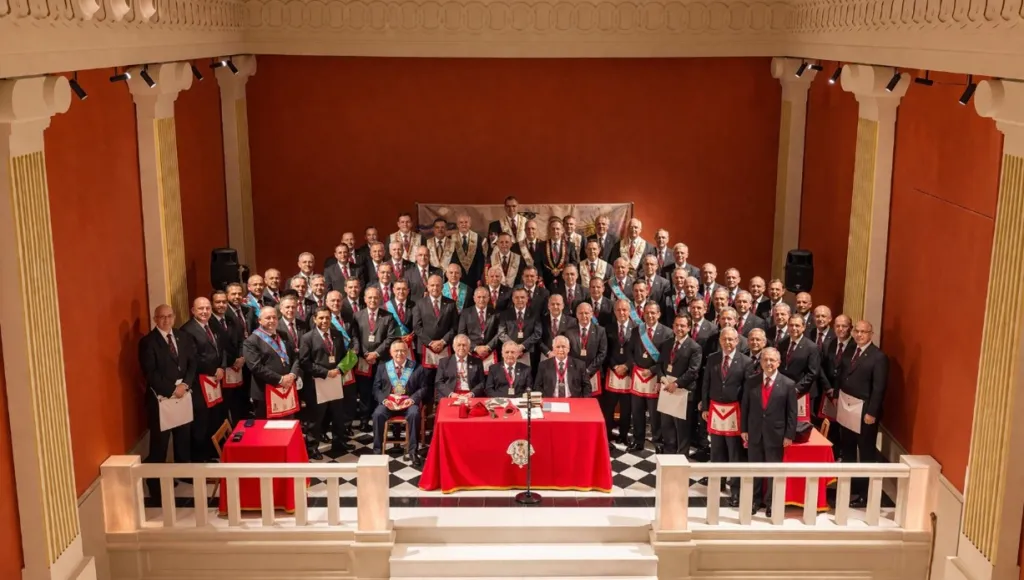
A total of 80 Freemasons attended this meeting, a number corresponding to the Temple’s current maximum capacity of 84 people. Among the attendees were prominent figures from the international Masonic community, such as the Grand Chancellor of the Grand Lodge of France, Martial Ouondo; the Secretary General of the International Confederation of United Grand Lodges; the Sovereign Grand Commander of the Supreme Council of Spain for the Ancient and Accepted Scottish Rite; as well as representatives of the National Grand Lodge of Portugal and the General Grand Lodge of Spain.
But beyond the figures and institutional representations, what was taking place inside the Temple took on a deeper dimension. After ninety years of inactivity, the columns once again bore witness to ritual work, the East symbolically radiated with Light, and the space regained its full significance. It was a moment of reflection, but also of affirmation: the certainty that Freemasonry, as a school of human betterment, does not depend exclusively on physical spaces, however profoundly significant they may be.
15 March 2026 will forever be etched in the history of Freemasonry in the Canary Islands. On that day, the Masonic Temple in Santa Cruz de Tenerife, located on Calle San Lucas, once again hosted Masonic meetings after nearly ninety years of silence. This was not merely the celebration of a solemn meeting of the Grand Lodge, but an event steeped in symbolism, memory and continuity.
The building, which closed in 1936 at the start of the Spanish Civil War and remained silent for decades, was recently restored and reopened to the public in October 2025. However, beyond its architectural restoration, what was truly significant was the restoration of its original function: to be a space for meeting, reflection and work for Freemasons.
The solemn meeting held inside the temple formed part of the events of the Grand Assembly of the Grand Lodge of the Canary Islands, which brought together Freemasons from various backgrounds this weekend in an atmosphere of brotherhood and respect. The programme included, amongst other activities, a welcome dinner at the Royal Casino of Tenerife, the Grand Lodge Assembly, a fraternal lunch and, as the highlight of the event, the Grand Meeting held within the temple itself.
A total of 80 Freemasons attended this meeting, a number corresponding to the Temple’s current maximum capacity of 84 people. Among the attendees were prominent figures from the international Masonic community, such as the Grand Chancellor of the Grand Lodge of France, Martial Ouondo; the Secretary General of the International Confederation of United Grand Lodges; the Sovereign Grand Commander of the Supreme Council of Spain for the Ancient and Accepted Scottish Rite; as well as representatives of the National Grand Lodge of Portugal and the General Grand Lodge of Spain.
But beyond the figures and institutional representations, what was taking place inside the Temple took on a deeper dimension. After ninety years of inactivity, the columns once again bore witness to ritual work, the East symbolically radiated with Light, and the space regained its full significance. It was a moment of reflection, but also of affirmation: the certainty that Freemasonry, as a school of human betterment, does not depend exclusively on physical spaces, however profoundly significant they may be.
At the opening of the proceedings, this idea was particularly emphasised: the outer Temple may be closed, but the inner Temple remains ever present in the consciousness of those who work for truth, freedom and fraternity. History has shown that circumstances may disrupt what is visible, but they cannot extinguish principles when they are rooted in human dignity.
At the opening of the proceedings, this idea was particularly emphasised: the outer Temple may be closed, but the inner Temple remains ever-present in the consciousness of those who work for truth, liberty and brotherhood. History has shown that circumstances may disrupt what is visible, but they cannot extinguish principles when they are rooted in human dignity.
The celebration of this Lodge meeting was therefore not an exercise in nostalgia, but a reaffirmation of continuity. Freemasonry is not a circumstantial reality, tied to a specific historical moment, but a structural tradition that transcends time, adapting to each era without renouncing its essential values.
The day concluded with a particularly moving moment: a violin rendition of the Ode to Joy, whose notes resonated beneath the vaulted ceiling of the Temple, a symbol of harmony, unity and hope. This conclusion perfectly encapsulated the spirit of the event: the reclaiming of a space, but above all, the reaffirmation of a commitment.
The Grand Lodge of the Canary Islands wishes to express its sincere gratitude to the City Council of Santa Cruz de Tenerife for its collaboration, and in particular to the Department of Culture, in the person of its councillor, Mr Santiago Díaz Mejías, whose involvement was fundamental in making it possible to hold this meeting of the Lodge at the Temple
Today, the Temple on San Lucas Street is being revived within Freemasonry. And with it, a simple yet profound idea is reaffirmed: the Work never ceases, the Light always finds a way to return, and the Temple, when founded on truth, endures..